
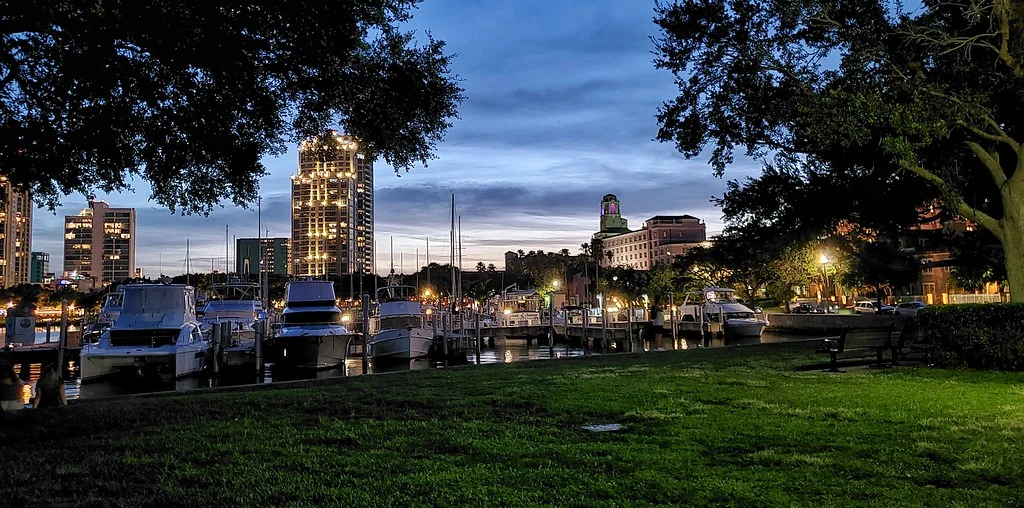
St. Petersburg’s waterfront event debate is moving into the paperwork that determines how a festival operates, how neighbors are informed and what happens when an organizer fails to respond to city instructions.
The November 12, 2026 Committee of the Whole agenda included a revised special-event co-sponsorship agreement and a draft handbook. Together, those documents outline a more detailed framework for events using city parkland.
WHY THE WATERFRONT IS BACK IN THE CONVERSATION
In his November 17 Tampa Bay Reporter article, Mark Parker connected the review to complaints following We Belong Here at Vinoy Park in December 2025. His report described sound being heard in Gulfport. That is attributed reporting about complaints, rather than an independent sound measurement by Nightlife Hangout.
Parker reported that administrators described stronger enforcement, including coordination among the community enrichment office and police and fire leadership before an active event is suspended. He also described more formal inspections, neighborhood notification and accountability for park damage.
The reporting captures the tension: a successful entertainment destination still has to function as a place where people live, work and use public parks.
WHAT THE CITY’S DRAFT ACTUALLY CONTAINS
The revised agreement in the city’s packet would let the city suspend, delay or terminate an event when a promoter does not comply promptly with city instructions. It would also allow future co-sponsorship to be withheld from a promoter and related entities under specified circumstances, including noncompliance or misrepresentation.
A dedicated sound clause prohibits amplified sound after 10 p.m. and before 1 p.m. on Sundays in that draft agreement. The neighborhood-impact form also addresses sound checks, speaker orientation, traffic, cleanup and park access.
The draft agreement makes promoters responsible for repair costs when city property is damaged.
The packet contains draft terms, rather than a signed festival agreement.
WHICH EVENTS ARE IN SCOPE?
The Parks & Recreation Department describes co-sponsored events as events held by or for a local nonprofit on city parkland, with qualifying activities such as admission charges, vending, donations or alcohol service. The program’s requirements should therefore be read in that context. A nightclub’s indoor operating conditions or a private-property event involves its own approvals.
WHAT HAS BEEN CONFIRMED ABOUT APPROVAL?
The city’s Committee of the Whole page states that committee actions become official council action only after approval at a regular council meeting. The November 12 materials include a handbook labeled draft.
At the November 21 editorial review, Nightlife Hangout had verified those materials and the published local reporting, but had not established a subsequent regular-council adoption date or an effective date for the entire package. The precise status of any individual contract also depends on that agreement. Describing every provision as a newly effective citywide noise law would go beyond the evidence reviewed.
OUR VIEW: THE BUSINESS QUESTION IS WHETHER THE PLAN WORKS
For an entertainment publication, the interesting test is how a written plan becomes an operating decision. A neighborhood notice can look complete on paper while leaving residents unsure whom to contact. A production schedule can list an end time while leaving the crew unclear about who is authorized to change a sound check or pause a performance.
Our view is that predictability helps everyone involved. An organizer should be able to explain the production plan to performers, vendors and neighbors. Residents should be able to understand the likely disruption and the route for raising a concern. City staff should have a clear process for communicating a correction and confirming that it happened.
There is also a practical difference between stopping a problem and turning a shutdown into a new crowd-management problem. That is why the event-day chain of responsibility matters alongside the wording of an enforcement clause.
The waterfront discussion deserves more than a choice between unrestricted concerts and no concerts. The useful questions are concrete: what did the organizer promise, what can the neighborhood reasonably expect, who makes the decision on site, and how will the outcome be assessed afterward?
Clearer neighborhood communication and an understood event-day decision process could give residents, organizers and production teams more predictable expectations.
Draft wording alone does not establish an adoption date, consistent enforcement or a workable show-day response. Those outcomes need evidence from the final process and actual events.
REPORTING SOURCES
City documents and published local reporting used to check this story. The final section is Nightlife Hangout’s editorial analysis.