
CONCERT ARTIST / R&B & Soul · Country · Jazz
Ray Charles
Soul, country and a musical identity strong enough to make the connection feel personal.
EXPLORE RAY CHARLES MUSIC ↓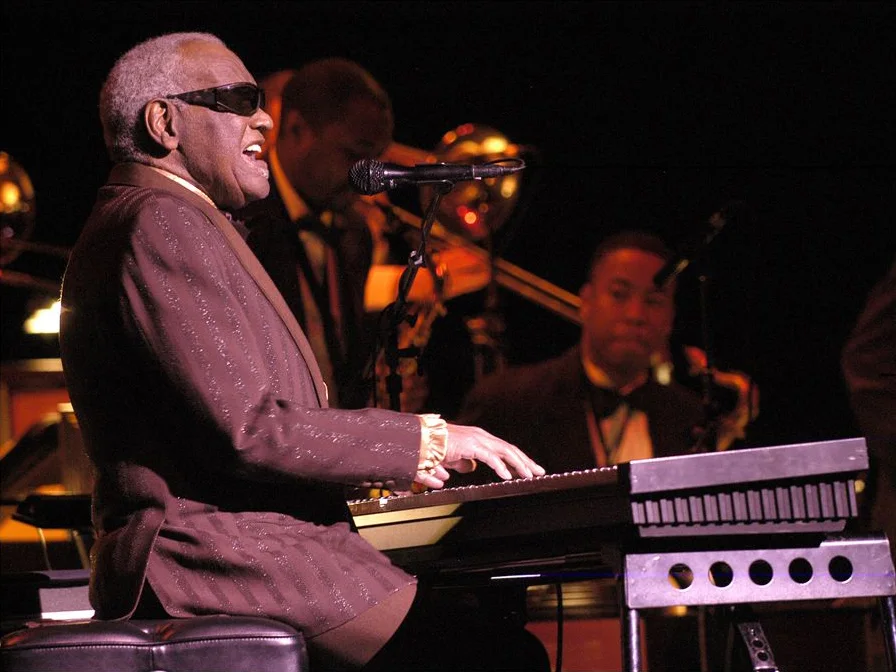
CHAPTER 01
A category does not get the last word
Ray Charles could make a conversation about genre feel smaller than the performance in front of it. His importance to soul music and his place in country history belong to the same career. Treating one as the main story and the other as a costume change leaves too much out.
The connection is the artist himself: a recognizable musical personality approaching different material without disappearing inside it. That is a more interesting kind of crossover than simply moving a track from one playlist to another.
CHAPTER 02
Georgia, Florida and an education in sound
Born in Albany, Georgia, in 1930, Charles grew up in Greenville, Florida. The Country Music Hall of Fame and Museum documents his education at the Florida School for the Deaf and Blind in St. Augustine, including learning music in Braille.
His story begins with specific places and skills, not with the finished legend. The later ability to work across musical traditions did not mean those traditions were interchangeable. It meant he had something distinctive to bring to the encounter.
CHAPTER 03
Soul becomes a personal language
His official biography places his pioneering work in soul during the 1950s and names tracks including “I’ve Got a Woman” and “What’d I Say.” The musical identity is not explained by one ingredient alone: blues, gospel and other traditions meet in a performer’s choices.
That is why the voice matters so much to the broader story. A song can come from a familiar tradition and still reach a listener differently through one particular person. Recognition and surprise do not have to cancel each other out.
CHAPTER 04
Country was a substantial chapter
Modern Sounds in Country and Western Music arrived in 1962. The museum identifies the album’s role in bringing wider attention to country material, including “I Can’t Stop Loving You.” This was a meaningful part of the catalogue, rather than a brief anecdote outside it.
The decision gives today’s crossover conversation some useful perspective. Genre connections existed before a social platform could turn them into a trend. Charles’s work makes the question concrete: what happens when a singer’s identity is strong enough to carry into another musical setting?
CHAPTER 05
The catalogue keeps the conversation open
Charles died in 2004 and was inducted into the Country Music Hall of Fame in 2021. This is a historical artist profile; his surviving catalogue is the route into the music.
The legacy is more rewarding than a list of labels conquered. It is the record of an artist able to make different traditions part of a recognizable voice. The boundary remains useful for explaining musical history. It becomes much less useful when it tells a listener that an artist is only allowed to belong in one room.
Listen
Ray Charles — What’d I Say on Apple Music ↗Performance archive
No historical performances are linked to this profile yet.